345% - 465%
Increase in new patient activity by location


Retail Case Study
A DFW clinic operator needed stronger patient growth and clearer guidance on where marketing dollars would produce the highest return.
The legacy approach leaned on broad regional targeting and delivered uneven performance across service areas.
Vado applied local patient-lookalike analysis and campaign testing to identify which neighborhoods could generate the strongest incremental impact.
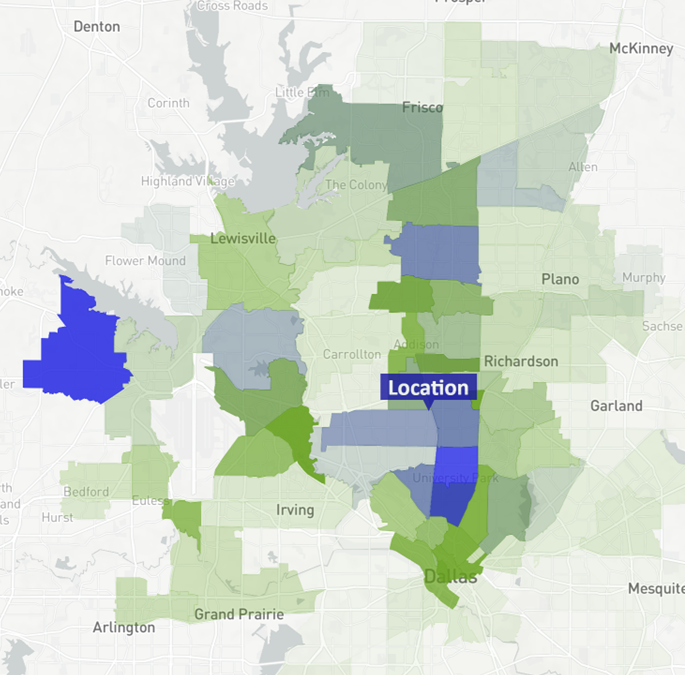
Past Customer Activity
345% - 465%
Increase in new patient activity by location
83% - 86%
New-patient volume from recommended zones
Higher ROI
Result from localized campaign structure
The project confirmed that local market targeting significantly outperformed a one-size-fits-all regional plan.
By tying spend to proven local opportunities, the client improved efficiency and gained a repeatable expansion model.
The clinic needed a measurable strategy that could raise patient volume without expanding spend into low-quality regions.
First-party activity was combined with market context to identify high-probability patient pockets.
Campaigns were launched by local zone with messaging tuned to neighborhood-level characteristics.
Performance was reviewed against baseline behavior to confirm incremental lift and optimize spend.
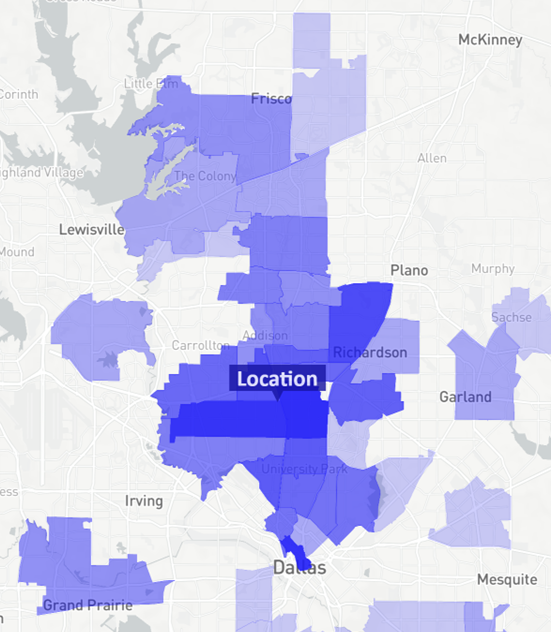
Recommended Target
The clinic shifted from broad regional execution to focused local targeting supported by continuous measurement.
Allocation decisions were then tied to validated local performance rather than generalized assumptions.
The localized strategy generated substantial patient growth and informed a more efficient operating model for future campaigns.
Locations saw significant lift once campaigns focused on local opportunity zones.
Most incremental growth came directly from recommended markets.
Regional spend was reduced in favor of higher-efficiency local activation.
No. The same local opportunity model can be used by single clinics and small groups.
First-party patient behavior and local market context are the core inputs for effective scoring.
Leading indicators often appear early when campaigns are localized and measured against baseline.