-14%
Underperforming geography removed


Retail Case Study
A Dallas-Fort Worth credit union needed to move beyond a north-Dallas concentration and improve growth in underpenetrated areas.
Vado reviewed branch draw, media response, and household similarity patterns to identify high-potential southern zones that looked more like the institution's strongest member segments.
Budget was rebalanced away from low-yield geography into expansion areas with better expected acquisition quality.
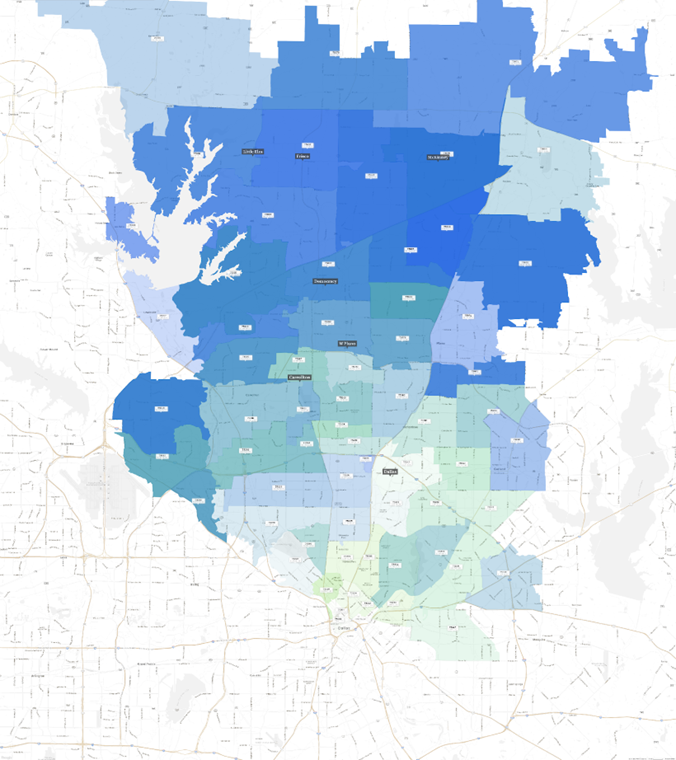
Past Customer Activity
-14%
Underperforming geography removed
+11%
Additional coverage funded by reallocation
43%
Share of new revenue from recommended area
The project showed that a smarter map can outperform a bigger map. Instead of increasing spend, the team concentrated resources where member similarity and response potential were materially higher.
This produced stronger engagement quality and made expansion more financially efficient without changing overall budget posture.
Growth was limited by legacy coverage assumptions that no longer matched where expansion-ready households were concentrated.
Current performance was mapped by neighborhood-level zones to isolate underperformance.
Top member traits were used to identify additional DFW households with similar financial and behavioral profiles.
The campaign footprint was rebuilt to remove waste and fund incremental high-potential reach.
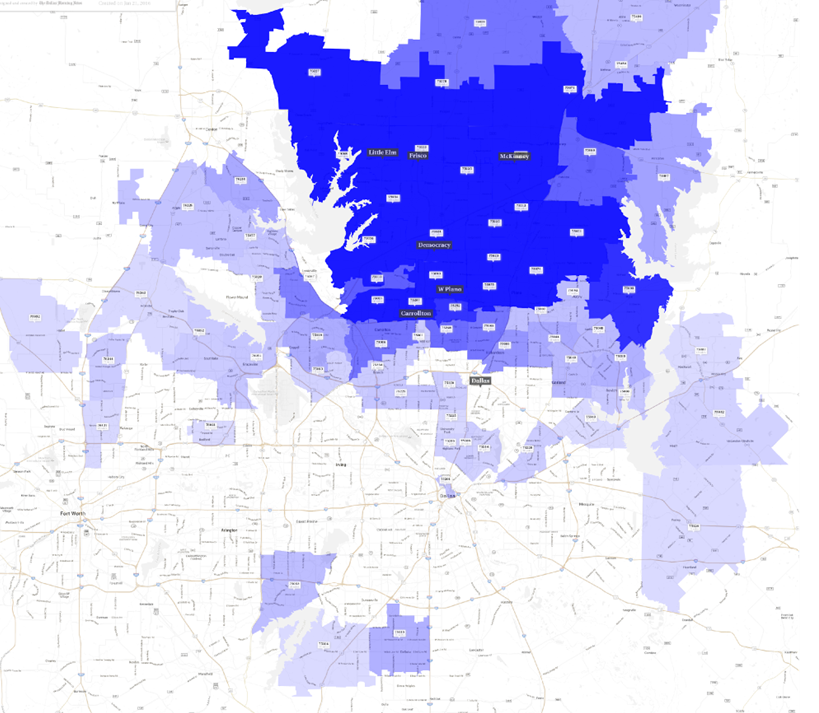
Recommended Target
The new plan concentrated media pressure in growth corridors and retained core-market presence only where returns justified investment.
Ongoing reporting by micro-area provided a repeatable framework for future market adjustments.
The credit union improved both expansion reach and conversion quality by letting data drive geography decisions.
Low-efficiency zones were cut to release budget for stronger markets.
Reallocated spend funded incremental footprint in higher-opportunity areas.
Recommended zones delivered substantially better response than historical trade areas.
No. Initial lift came from media and geography optimization around the existing branch network.
Areas were scored on engagement and conversion quality, then compared against lookalike opportunity zones.
Yes. The same market mapping and reallocation framework is portable across branch markets.