0.25 mi
Final site distance from ideal recommendation


New Location Case Study
A national home goods and furniture chain needed a Tampa site that complemented its flagship location and competed effectively for market share.
Vado used third-party mobility data to map trade-area behavior for the client and key competitors, then evaluated neighborhoods by access, overlap risk, and household fit.
This gave the real-estate team a ranked short list and clearer confidence around which area would maximize draw potential for the new concept.
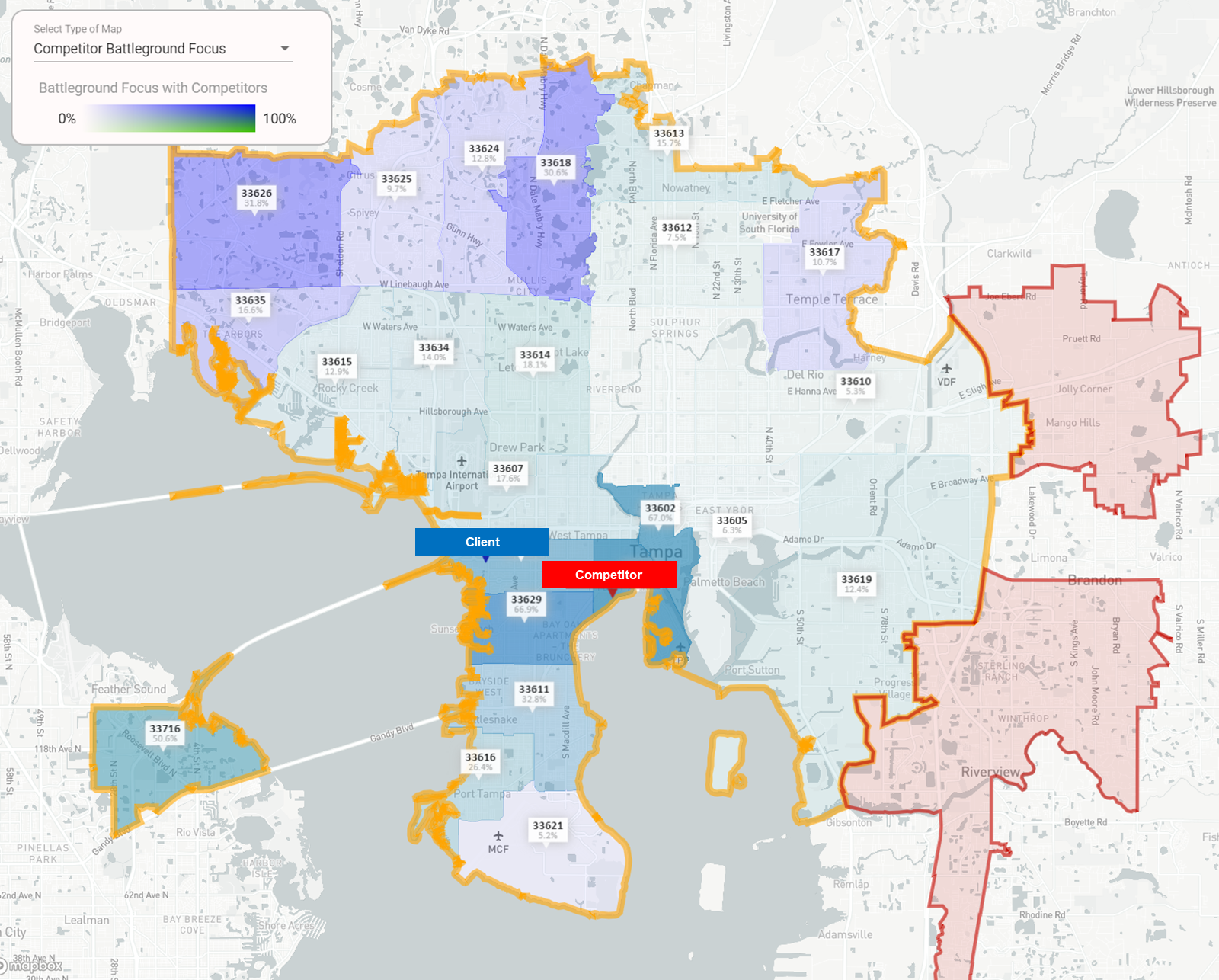
New Location Trade Area
0.25 mi
Final site distance from ideal recommendation
High Access
Convenient highway-connected trade area
2+ Years
Sustained post-opening success
The project reduced location risk by replacing intuition-led site selection with measured trade-area evidence.
The chosen site closely matched the recommended zone and provided a durable base for launch and long-term operations.
The client needed to add a new location without cannibalizing the flagship while still taking share from a primary competitor.
Visitor origin and travel behavior were mapped for both client and competitor locations.
Neighborhoods were ranked by similarity to existing high-value customer profiles.
The analytical recommendation was translated into a practical search area for property evaluation.
This case focused on expansion precision: selecting a site that complemented the existing footprint while maximizing new demand capture.
The client selected a site within one quarter mile of the modeled ideal area and used the analysis to align launch planning with expected trade-area behavior.
This reduced launch uncertainty and improved confidence in long-term location viability.
The final location aligned tightly with the recommendation and has continued to perform successfully.
Real-estate execution matched the modeled opportunity zone with high precision.
Accessibility advantages improved draw potential across the metro footprint.
Performance sustained beyond initial launch momentum.
Mobility patterns reveal actual travel and visitation behavior that static radius assumptions often miss.
Closer is generally better if property and access conditions align, as seen in this project.
Yes. The same framework can be repeated and localized for additional markets.